
Aircraft Maintenance Assist
Your task cards and your experience, recorded — with the manual one tap away.
A record-keeping tool for aircraft maintenance technicians. Record what you do each day as task cards, keep them organised by aircraft, operator and ATA chapter, and build a lasting record of the working experience they represent.
iPhone, iPad and Mac · English, 简体中文, 繁體中文 · No subscription, no in-app purchases
What it does
Recording your work is what the app is for, and it needs no account. Manual lookup is an optional extra for technicians who already hold their own portal access.
Your work, recorded
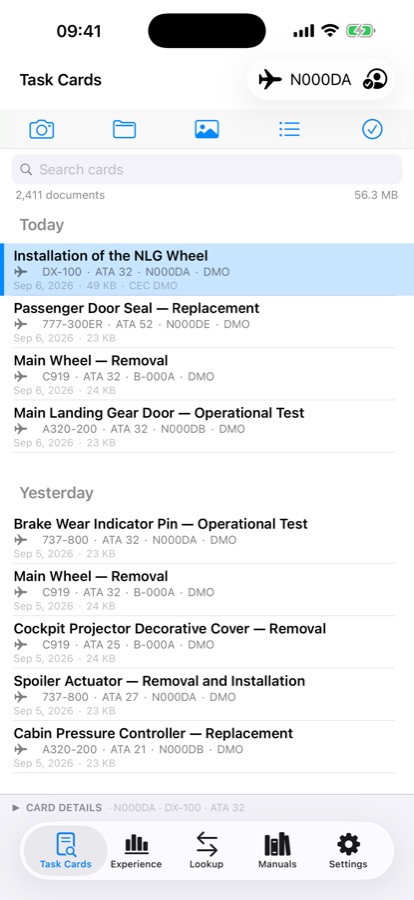
- Scan a paper task card with the camera — edges, perspective and shadows are corrected for you.
- Or import a PDF or photo you already have.
- On-device text recognition reads the card and fills in its details: title, ATA chapter, aircraft type, registration and operator.
- Edit any detail yourself, and add a remark in your own words.
Your experience, demonstrated
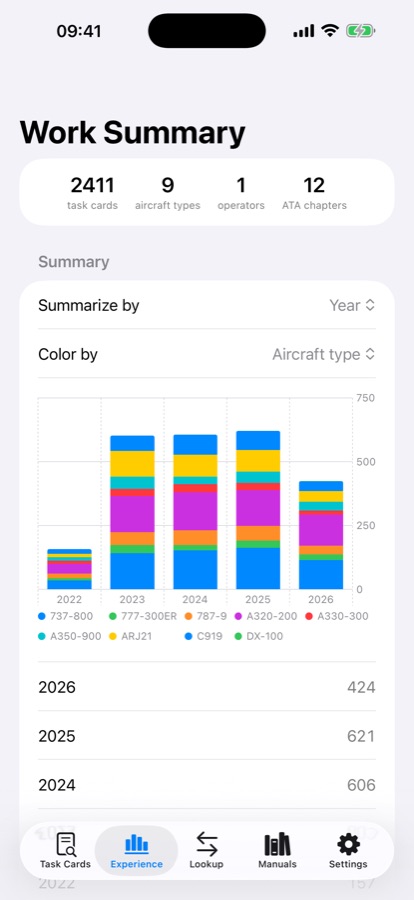
- The Experience tab totals your cards by aircraft type, operator, ATA chapter, month and year.
- One airline counts as one airline, even when your cards came from different portals that each spell its name differently.
- Cross-tabulate rows and columns any way you need, then save a report image straight to Photos.
- Cards keep counting after their documents are cleaned up.
Find it in the manual
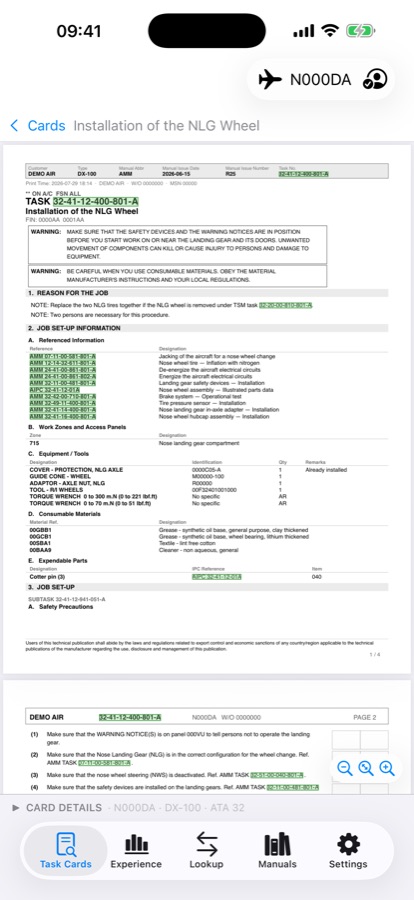
- With your own Airbus airnavX, MyBoeingFleet or COMAC FLYWIN account, tap a code on a card — a task number, a page block or an S1000D data module — and the matching manual document opens beside it.
- Codes inside a manual are tappable too, so you can follow a reference chain.
- A reference resolves through the manual's own table of contents, so it opens the document your aircraft's library actually holds — or tells you plainly that it holds none.
- Off by default. Everything else works without any account.
Yours, and private
- Cards live on your device, or in your own iCloud Drive — your choice, and you can switch at any time.
- No developer server, no analytics, no tracking, no advertising.
- Sign-in, if you use it, happens on the provider's own web page. Face ID or Touch ID can protect a saved sign-in.
- Every card is two ordinary files you can copy anywhere: the document and a small details file.
See it on your device
The same library on iPhone, iPad and Mac. All data shown is fictional.
On iPhone: your cards, the task links on them, and what they add up to.
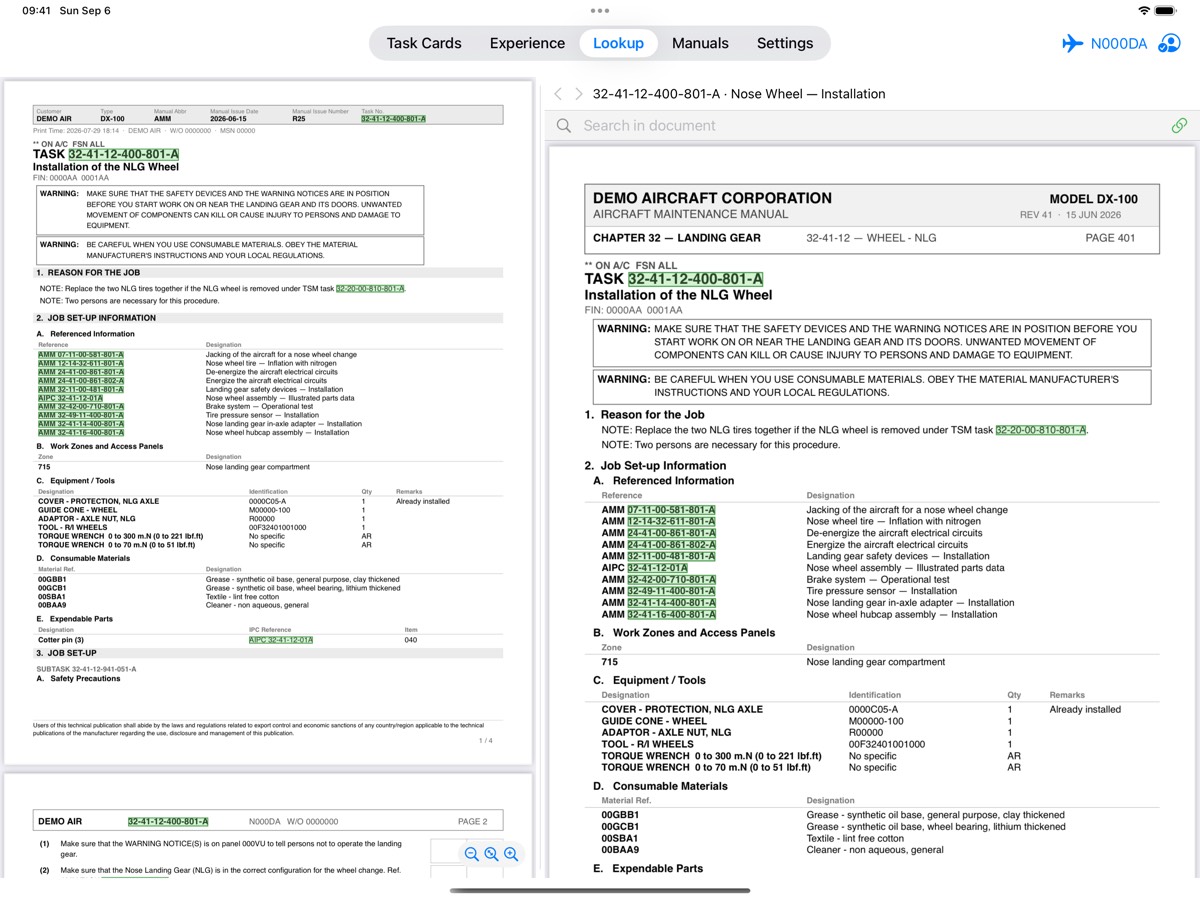
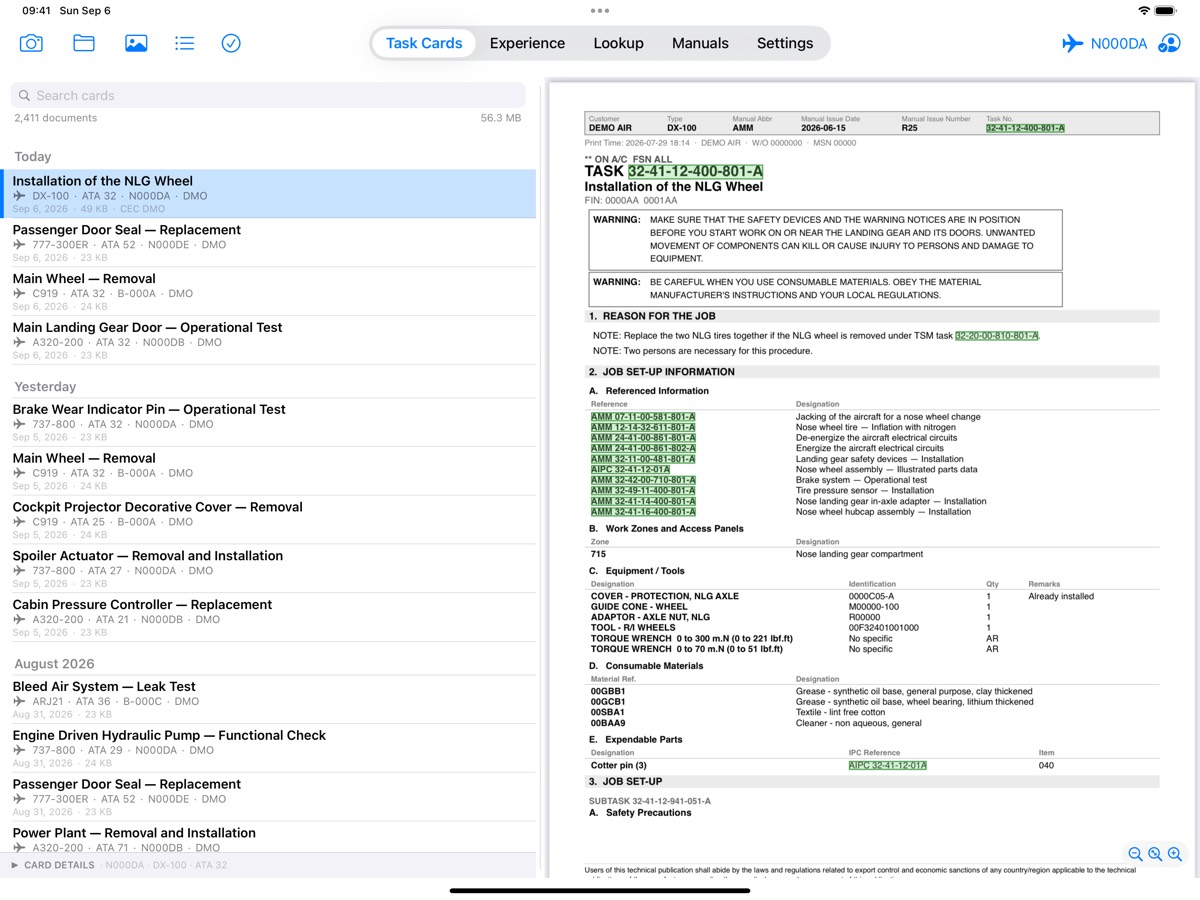
On iPad: the card and the document it points to, side by side.
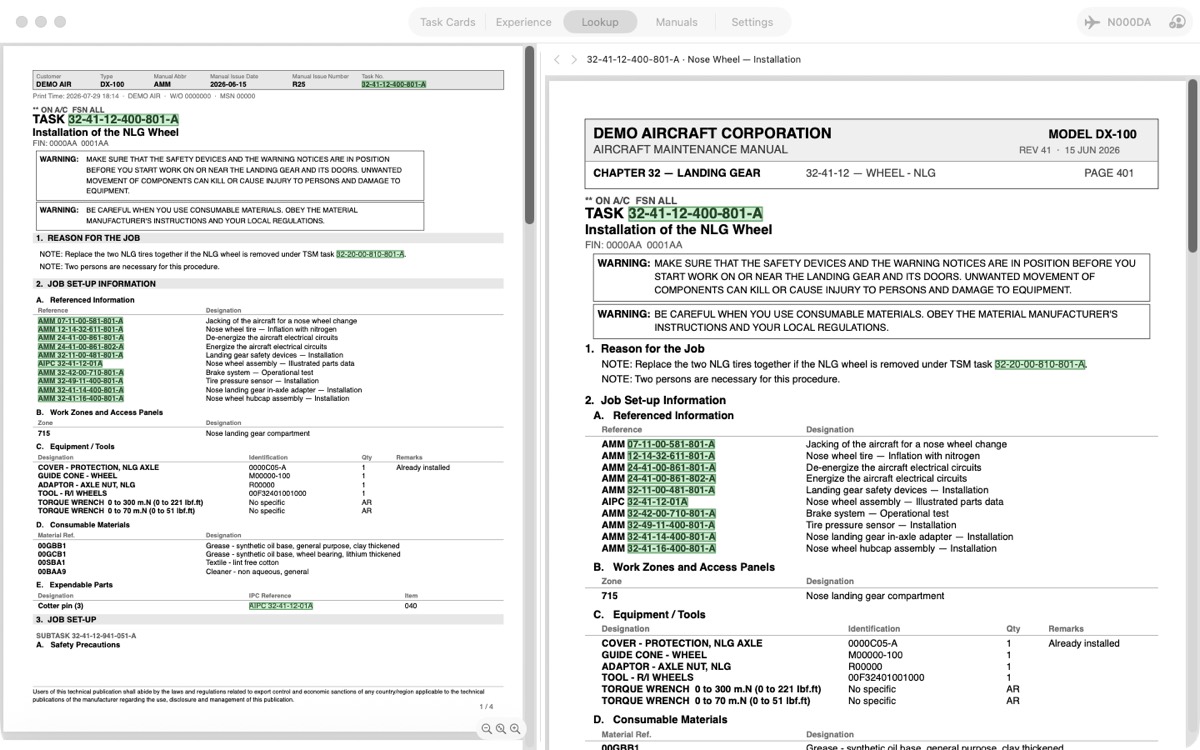
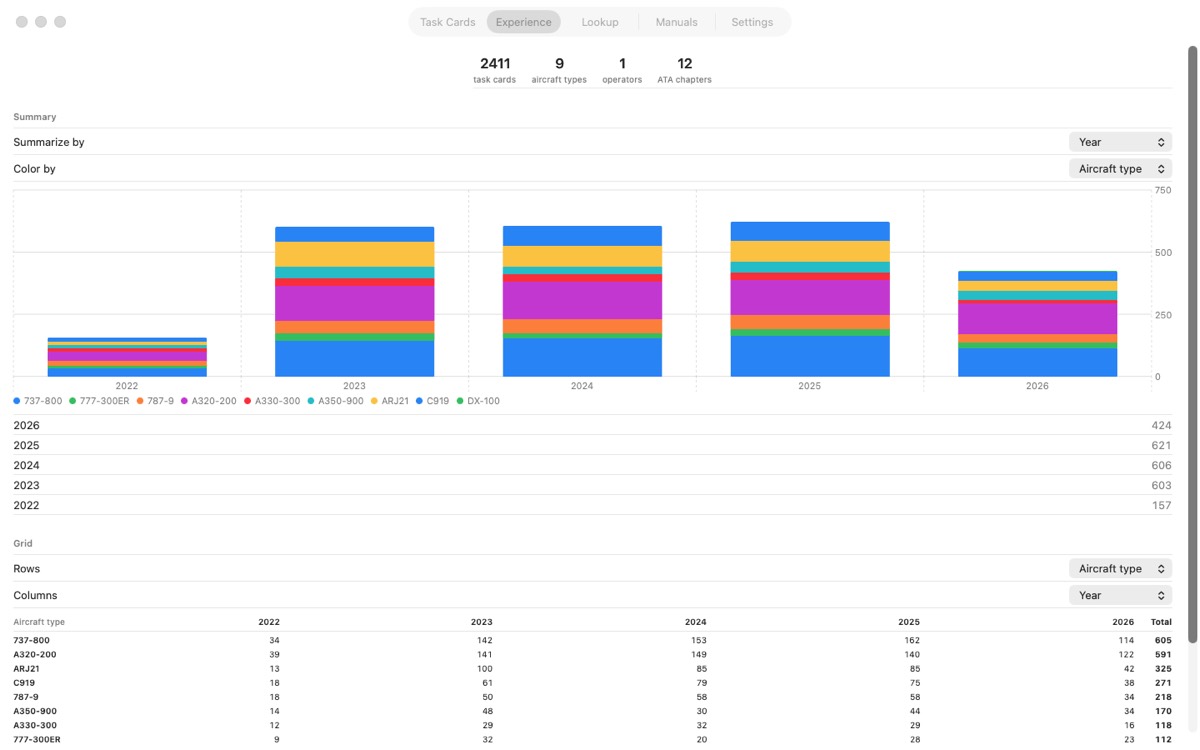
On Mac: the same library, in a window.
New in version 2.0
- Airbus manuals. Manual lookup now works with your own Airbus airnavX account, alongside MyBoeingFleet and COMAC FLYWIN. Each card says which portal it looks up in, chosen in Card Details.
- The right document, or a plain answer. Tapping a reference opens the document your aircraft's own library holds, found through the manual's table of contents — and says so when the library holds none, instead of opening something close.
- One airline, one name. Experience totals count one airline once, whichever portal a card came from. Card Details shows the airline code with the portal's own name beside it.
- A switch per portal. Settings ▸ Manual Sources has one switch for each portal, so the app only offers the ones you actually hold an account for.
- A first-run guide that points at the real controls — where to add a card, where to sign in, and what each tab is for.
Getting started
Steps 1 and 6 are all you need to keep a record. Steps 2 to 5 add manual lookup, if you have a portal account.
- Add a task cardScan a paper card, import a PDF, or pick a photo, from the buttons at the top of Task Cards.
- Turn on a manual sourceOptional. In Settings ▸ Manual Sources, switch on the portal you hold an account for.
- Sign inTap the account icon at the top right, and sign in on the portal's own page.
- Set the card's aircraftIn Card Details, at the bottom of the card, pick its type and registration.
- Tap a task linkHighlighted references open their manual document beside the card, in Lookup.
- Watch your record growThe Experience tab totals everything you have filed, by aircraft, operator, ATA and year.
Support
Email: ama@softonthego.com
Please include your device model, your iOS, iPadOS or macOS version, and the app version. If the problem is visible on screen, a screenshot helps. Replies usually come within a few working days.
For a technical fault, use Settings ▸ Support ▸ Report a Problem in the app. It builds a diagnostic bundle on your device and hands it to the share sheet — you can attach it to your email. Nothing is sent unless you send it, so do look through it first.
Common questions
Do I need an account to use the app?
No. Recording task cards, reading and editing them, the Experience totals and the report image all work without any account and without a network connection. An account is only needed for the optional manual lookup.
How do I turn on manual lookup?
Go to Settings ▸ Manual Sources and switch on the portal you hold your own account for: Airbus airnavX, MyBoeingFleet or COMAC FLYWIN. Then tap the account icon at the top right and sign in on the portal's own page.
Once you are signed in, the Manuals tab appears, and references on your cards become tappable. All three switches are off by default.
Why isn't a code on my card highlighted?
A reference is only highlighted when tapping it can actually open something. That means the card is filed under a portal that is switched on in Manual Sources, and either the card's aircraft is set in Card Details or you are signed in to that portal.
A card whose source is None shows its codes as plain text. Pick a source for it in Card Details.
It says the aircraft's library has no such manual. What now?
From version 2.0 a reference is resolved through the manual's own table of contents, for the aircraft set on the card. If that aircraft's library does not hold the document, the app says so rather than opening something that only looks close.
Check the aircraft in Card Details. You can also browse for the document in the Manuals tab.
Why does the operator show a code and a name?
Different portals spell the same airline differently. The app files each card under the airline's code, which every portal shares, so your Experience totals count one airline once. The portal's own spelling is shown beside it, read-only, as it stood when you filed the card.
Where are my task cards stored?
On your device, or — if you turn on iCloud storage in Settings ▸ Storage — in your own iCloud Drive, where Apple syncs them between your devices. You can switch at any time, and the app moves your files for you. Nothing is sent to the developer; there is no server behind this app.
A card shows its details but no document. Why?
That is expected for an older card if Automatic Cleanup is on. Cleanup frees storage by removing the documents of old cards while keeping their details as your permanent work record. Those cards still count in your Experience totals, and their details become read-only.
You can turn this off in Settings ▸ Automatic Cleanup.
My library looks wrong after moving between devices.
Use Settings ▸ Library Check ▸ Validate & Rebuild Library. It checks every file
in your task card folder, sets aside anything it cannot recognise into an Unrecognized
folder for you to review, and rebuilds the index from the details files that remain. It never deletes
anything.
Can I get my data out?
Yes, and you don't need the app to do it. Every card is two ordinary files side by side in your task card folder: the document (PDF or image) and a small JSON file holding its details. Open the folder in Files or Finder and copy them anywhere. The Experience tab can also save a report image to Photos.
Which manual references does the app recognise?
Classic ATA task numbers and page blocks, figure and item references, and S1000D data module codes — including references that wrap onto the next line or sit inside a table. A reference carrying a manual abbreviation (AMM, AIPC, IPC, FIM, TSM, SSM, ASM, WDM, AWM, SRM or MPP) goes to that manual.
Does the app collect any data about me?
No. There is no analytics, no tracking, no advertising and no developer server, and nothing is transmitted automatically. The full policy is at /privacy/.
Is the app connected to Airbus, Boeing or COMAC?
No. Aircraft Maintenance Assist is an independent tool. It grants no access to any portal: you see only what your own account is entitled to see, and each provider enforces its own permissions.